For years, WordPress was the default answer for almost every website project. Need a blog? WordPress. Need a company site? WordPress. Need eCommerce? Add WooCommerce. Need memberships, SEO, forms, courses, bookings, or a page builder? There’s a plugin for that too.
And honestly, that ecosystem is exactly why WordPress became so dominant.
But after building websites and platforms for clients for more than 15 years, we started noticing the same pattern over and over again:
The website launches looked great.
The admin experience did not.
Clients would come back frustrated because they were afraid to update content. Simple edits felt risky. The backend became cluttered with plugin settings, technical terminology, builder conflicts, update warnings, and performance issues.
Instead of empowering clients to manage their content, the CMS itself became another dependency.
That’s why we built theDavid.
The Real Problem Wasn’t WordPress Itself
WordPress is not a bad platform.
In fact, it solved an important problem at the right time. It democratized publishing and made websites accessible to millions of people.
The issue is what modern WordPress projects have become.
Today, most professional WordPress builds rely on:
Multiple third-party plugins
Visual builders layered on top of builders
Heavy themes
Frequent maintenance
Security hardening
Constant updates
Compatibility troubleshooting
And ironically, the more “custom” a WordPress site becomes, the less friendly it becomes for the actual business owner.
The admin panel slowly turns into something optimized for developers instead of content managers.
That was the breaking point for us.
We Wanted Clients to Focus on Content
When we started designing theDavid, we asked a simple question:
What if the CMS disappeared into the background?
Not literally. But conceptually.
The goal was to remove friction between the business owner and the content they want to publish.
We didn’t want clients thinking about:
Plugins
Cache issues
Theme overrides
Gutenberg blocks breaking layouts
Builder updates
PHP versions
Security patches
We wanted them focused on:
Writing pages
Updating menus
Publishing blog posts
Managing products
Uploading media
Running their business
That became the foundation of theDavid.
We Built the CMS Around the Front End
One of the biggest compromises with traditional CMS platforms is design.
Most systems start from the backend and then try to force design into templates afterward.
We approached it differently.
At Digital Potter, we are deeply frontend-focused. We care about:
User experience
Performance
Typography
Layout systems
Motion
Mobile responsiveness
Clean interfaces
Brand consistency
So instead of designing around backend limitations, we built a CMS that supports true frontend freedom.
The frontend is treated as a real application, not just a theme layer.
That means:
Custom storefronts
Fully custom marketing pages
Modern React and Next.js architecture
API-driven rendering
Faster experiences
Better SEO control
Cleaner deployment pipelines
The CMS exists to support the design, not fight against it.
Templates Without Losing Control
One thing WordPress does well is flexibility.
We didn’t want to lose that.
But flexibility without boundaries usually creates chaos.
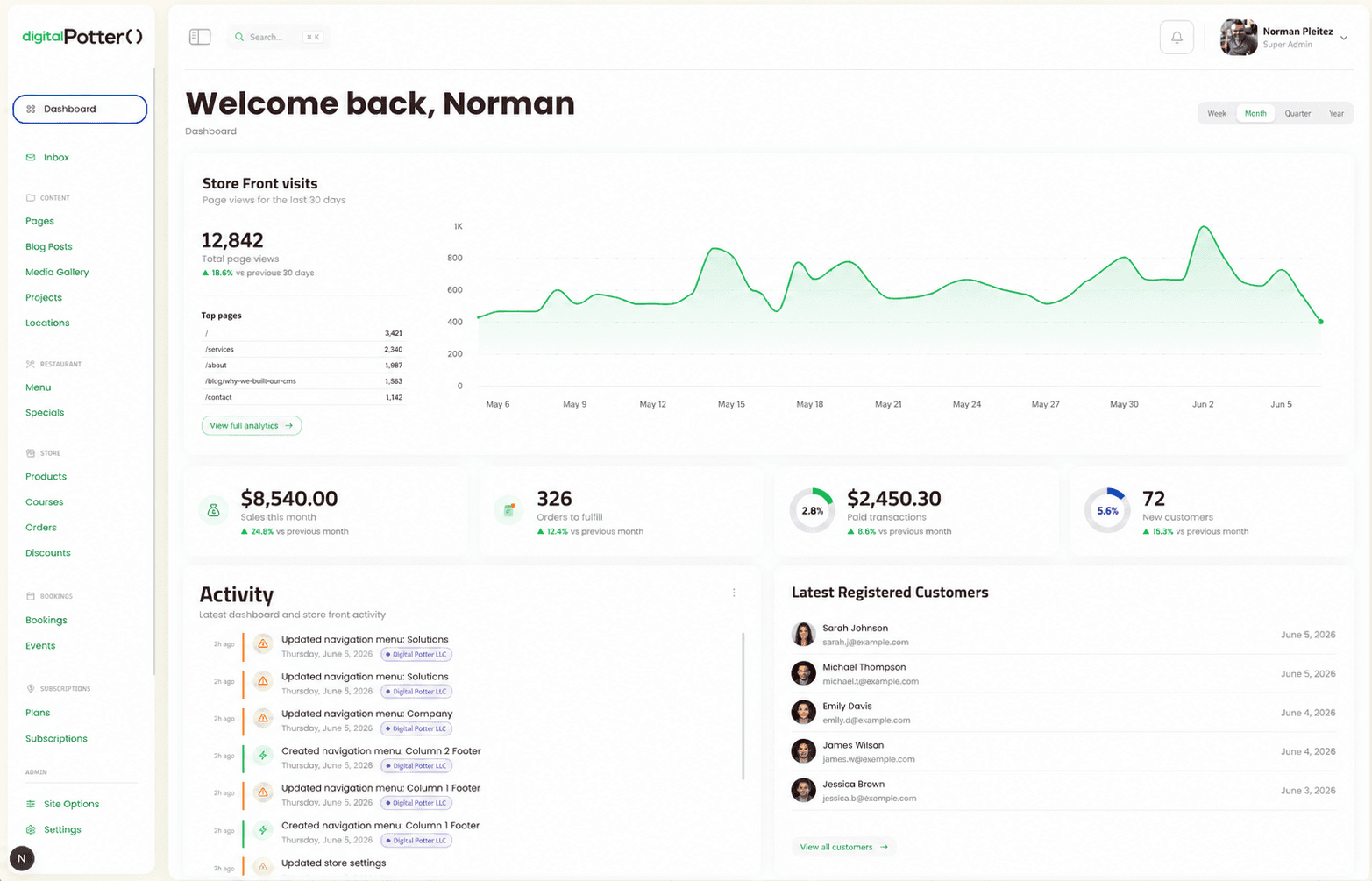
So with theDavid, we built a system where clients can safely update what matters while preserving the integrity of the design.
Instead of giving users unlimited access to destroy layouts accidentally, we created structured flexibility:
Reusable sections
Controlled content areas
Dynamic navigation management
SEO settings
Global site configuration
Tenant-based content management
Page templates
Media management
Product and course systems
Booking and event management
The result is a cleaner editing experience where non-technical users feel comfortable making updates.
That matters more than most developers realize.
Security Was Another Major Factor
Open ecosystems create innovation.
They also create attack surfaces.
A typical WordPress installation often depends on dozens of plugins written by different developers with different coding standards and maintenance schedules.
That introduces:
Vulnerabilities
Plugin abandonment
Compatibility conflicts
Performance bloat
Update risks
We wanted tighter control over the stack.
With theDavid:
We control the architecture
We control the integrations
We control the release cycle
We control the data structure
We control the permissions system
That dramatically reduces unpredictability.
No platform is magically “unhackable,” but owning the architecture gives us significantly more confidence in stability and security.
Headless Was the Right Direction
Modern websites are no longer just websites.
Clients want:
Mobile apps
APIs
eCommerce
Booking systems
Multi-location support
Marketing pages
SEO optimization
Social integrations
Future scalability
A headless architecture made more sense for where the web is going.
theDavid separates content management from presentation.
That gives us the ability to:
Build frontend experiences in Next.js
Power mobile apps
Create custom storefronts
Integrate with third-party services cleanly
Scale infrastructure independently
Optimize performance aggressively
Instead of fighting against the CMS, we use it as infrastructure.
The Trade-Offs We Made on Purpose
Building your own CMS sounds exciting until you realize how much work it actually is.
We knowingly accepted several trade-offs.
1. We Gave Up the Plugin Marketplace
There is no giant plugin directory.
That means fewer one-click installs.
But it also means:
Better consistency
Better performance
Better security
Better UX control
We would rather build fewer features properly than rely on 20 disconnected plugins.
2. We Accepted More Engineering Responsibility
When you own the platform, there’s nowhere to hide.
We maintain:
Infrastructure
APIs
Admin systems
Frontend integrations
Authentication
Media handling
Permissions
Deployment workflows
That is significantly more responsibility than installing WordPress.
But it also means we can evolve the platform intentionally.
3. We Optimized for Long-Term Product Quality
WordPress is faster to launch initially.
No question.
But over time, custom WordPress projects often become increasingly fragile.
We built theDavid for long-term maintainability.
That meant:
Cleaner architecture
Better scalability
More predictable deployments
Better frontend standards
Modern tooling
Structured extensibility
The upfront investment was larger, but the long-term payoff has been worth it.
A CMS Should Support Creativity, Not Limit It
At the end of the day, this was never about “competing with WordPress.”
WordPress still serves millions of websites successfully.
This was about building the platform we wished existed for our own clients.
A CMS should help businesses move faster.
It should make content easier to manage.
It should protect design quality.
It should reduce technical anxiety.
It should feel modern.
Most importantly, it should stay out of the way.
That’s why we built theDavid.